
A franchisor can be legally allowed to sell in one state and not in the one next door. The reason is a short list of franchise registration states, where regulators review a brand's disclosure document before the brand may offer you a franchise. If you're comparing brands, knowing which side of that line your home state sits on tells you what protection exists and which question to ask first: "Are you registered here?"
It's a quick check, and a franchisor that's selling properly will answer it without blinking.
Federal rule vs. state law
Two layers of rules apply when a franchise is sold in the United States.
The first is federal. The FTC's Franchise Rule (16 CFR Part 436) applies nationwide. It requires a franchisor to hand you a Franchise Disclosure Document, the FDD, at least 14 calendar days before you sign a binding agreement or make any payment to the franchisor or an affiliate. It also dictates the 23 items the FDD must contain. You can read the rule text on eCFR and the FTC's overview of the Franchise Rule.
The second layer is state law. Some states add their own requirements on top of the federal rule. The federal rule doesn't require anyone to approve an FDD before it's used. Certain states do.
If you haven't read an FDD before, our guide to how to buy a franchise shows where the document fits in the overall process.
Registration states
Roughly 13 to 14 states require a franchisor to register its FDD with a state agency before offering or selling a franchise there. The count depends on who's counting. One 2025 summary from FranNet lists 13; an older law-firm overview lists 14 by including South Dakota. States that commonly appear on these lists include California, Illinois, Maryland, Minnesota, New York, and Washington. We aren't publishing a full list here on purpose, because lists change and a blog post can be out of date the day after it's published. Check the state regulator's own site.
In a registration state, a franchisor typically files its FDD, pays a fee, and responds to comments from the reviewing agency. Until the filing is effective, it shouldn't be offering you a franchise there.
A few additional states, according to FranNet's 2025 summary, require registration only when a brand's principal trademarks aren't federally registered with the USPTO. So the answer can differ from one brand to the next, even in the same state.
Filing and notice states
Some states sit in the middle. Florida and Texas, for example, are described as filing states: the franchisor submits a notice or a copy of the FDD, but the agency doesn't conduct the in-depth review that happens in a registration state. Other states have business-opportunity laws, with their own notice or exemption filings that can apply to certain offerings.
The practical point is this: "filing" doesn't mean "reviewed." If your state is a filing or notice state, nobody at the agency has necessarily read the FDD line by line on your behalf.
What registration does and doesn't mean
Here's the part that gets misunderstood.
Registration means the franchisor submitted its FDD to a regulator, and the regulator reviewed it for compliance with that state's disclosure requirements. It also means the franchisor has a current filing you can ask about.
Registration doesn't mean the state has endorsed the brand, vetted its business model, or checked that you'll do well. It isn't a recommendation. It isn't a promise about results. A regulator reviewing disclosure is a different thing from a regulator predicting success, and no registration filing makes any statement about what an owner will earn.
It also doesn't replace your own work: reading the FDD, calling owners, and having professionals review the agreement.
How to check a brand
You don't need a law degree for this. Here's a simple routine.
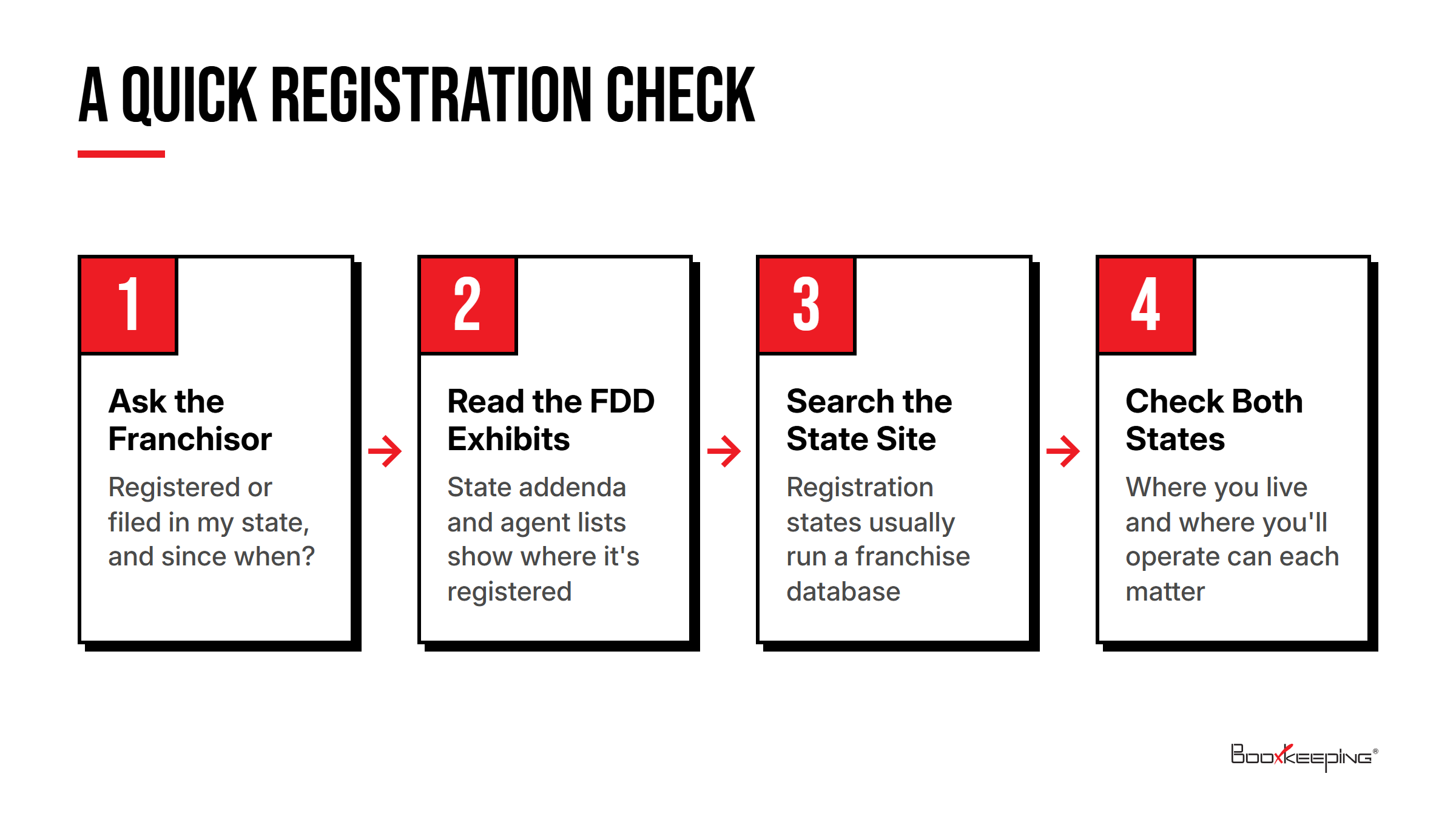
- Ask the franchisor directly. "Is your FDD currently registered or filed in my state, and what's the effective date?" A clear answer comes quickly.
- Look at the FDD itself. The state-specific addenda and the list of state agencies and agents for service of process, usually in the exhibits, show where the brand is registered and who to contact.
- Check the state's own website. The securities or business regulator in registration states usually runs a searchable franchise database. NASAA lists 21 agencies with franchise or business-opportunity authority, which makes a good starting directory.
- Ask about both states if you live in one and will operate in another. Where you live and where you'll open can each matter, and your attorney can sort out which applies.
If a brand says it's exempt, ask on what basis. That's a normal question.
Questions for your attorney
A franchise attorney can tell you what your state's law adds. Bring these:
- Which of the state's franchise protections apply to a purchase where I live and where I'll operate?
- Is this franchisor properly registered or filed here, and is the filing current?
- Does the state addendum in the FDD change any contract terms, such as governing law or where disputes are heard?
- If the franchisor claims an exemption, does it hold up?
Our guide to validation calls covers the owner-side questions that complement the legal ones.
Frequently asked questions
Does a brand have to be registered in every state?
No. Only the registration states require review before a sale, and a few more require a filing or notice. Elsewhere, the federal Franchise Rule is the main framework.
If a brand isn't registered in my state, is it a bad sign?
Not by itself. A brand may be in the middle of its registration, or may simply not be selling in your state yet. It becomes a problem only if the franchisor offers you a franchise there without a required filing, so ask before you go further.
Can I still look at an FDD while registration is pending?
Often yes, but the franchisor can't lawfully sell to you in a registration state until its filing is effective. Don't pay or sign anything in the meantime.
Your next step
Once you know whether a brand you like has a current filing, you can move on to the slower parts: reading the FDD, talking with owners, and meeting the team. If it helps to see the sequence, our ownership process page walks through it, and the FAQ covers common early questions. You may also want our complete guide to bookkeeping franchises or our rundown of what happens at a discovery day.
If you'd like to see how a bookkeeping franchise would work where you live, you can explore ownership with BooXkeeping and start a conversation. We'll tell you plainly whether we're set up to sell in your state.
This article is general information for people researching franchise ownership. It isn't legal, tax, financial, or investment advice, and it isn't an offer to sell a franchise. A franchise offering is made only through a Franchise Disclosure Document. Talk with a franchise attorney, a CPA, and a financial advisor about your situation before you invest.